
The Cure on Vinyl – Melancholy, Mystery and the Art of the Album
Some bands make songs. Others create entire worlds.
The Cure belong firmly in the second category. From the early post-punk shadows of Seventeen Seconds and Faith to the dark grandeur of Disintegration and the colourful pop brilliance of Kiss Me, Kiss Me, Kiss Me, The Cure have built a catalogue where mood, artwork, sound and atmosphere all matter.
That is exactly why their music works so beautifully on vinyl.
At Mr. Hansen Records, The Cure are not just filed under “Rock” or “Alternative”. They belong to that special group of artists where the record itself feels like part of the experience. The cover, the inner sleeve, the sequencing, the sound of the needle finding the groove — it all adds something.

More Than Just Gothic Rock
The Cure are often described as gothic rock, but that only tells part of the story.
Yes, there is darkness. There is melancholy, atmosphere and emotional weight. But there is also colour, humour, pop instinct and a surprising amount of warmth. Robert Smith’s songwriting can move from despair to sweetness, from claustrophobic minimalism to bright, almost perfect pop.
That contrast is what makes The Cure so lasting.
A song like A Forest feels cold, hypnotic and mysterious. Just Like Heaven is pure melodic electricity. Pictures of Youstretches time in the way only great vinyl-side music can. The Cure can be fragile, strange, romantic, anxious, playful and monumental — sometimes all within the same album.

Why The Cure Matter to Vinyl Collectors
The Cure are a perfect example of why vinyl collecting is not only about rarity or price.
Their albums were designed as complete statements. The mood changes from record to record, and each era has its own visual language. Early pressings, later reissues, picture discs, coloured vinyl, 12-inch singles and compilations all tell different parts of the story.
For collectors, this makes The Cure especially rewarding. You are not only collecting a band — you are collecting periods, moods and identities.
The early records have a stripped-down, post-punk intensity. The mid-1980s albums open up into bigger, stranger and more colourful territory. By the time you reach Disintegration, the sound becomes vast and cinematic, one of the great late-night albums in alternative rock.

The Album as an Object
One of the pleasures of collecting The Cure on vinyl is how strongly the music connects with the physical format.
The artwork is rarely accidental. The covers often feel blurred, dreamlike or emotionally distant — perfectly matched to the sound inside. On vinyl, that matters. A large sleeve gives the artwork space to breathe. It invites the listener to slow down and enter the album before the music even begins.
That is something streaming can never fully replace.
A Cure record is not just a playlist of songs. It is a room you step into.
Where to Start
For new collectors, The Cure catalogue can feel a little overwhelming, but that is part of the fun.
If you want the darker side, start with Seventeen Seconds, Faith or Pornography.
If you want the perfect balance of pop and atmosphere, The Head on the Door and Kiss Me, Kiss Me, Kiss Me are wonderful places to begin.
If you want the grand statement, the album many fans consider the masterpiece, then Disintegration is essential.
And if you want the hits, compilations such as Standing on a Beach or Galore give a strong overview of how wide their musical world really is.

Condition Matters
With Cure records, condition is especially important.
Many original copies were played heavily. These were not records people bought and left untouched on a shelf. They were lived with. They were played in bedrooms, student flats, record shops and late-night rooms with too little light and too much emotion.
That is part of the charm — but it also means careful grading matters.
At Mr. Hansen Records, records are conservatively graded according to the Goldmine Standard. Pre-owned vinyl is professionally cleaned and visually inspected, and condition notes are updated as records are reviewed. New and sealed records are not opened before sale, because the sealed condition is part of their value and collector appeal.
The Story Behind the Cover
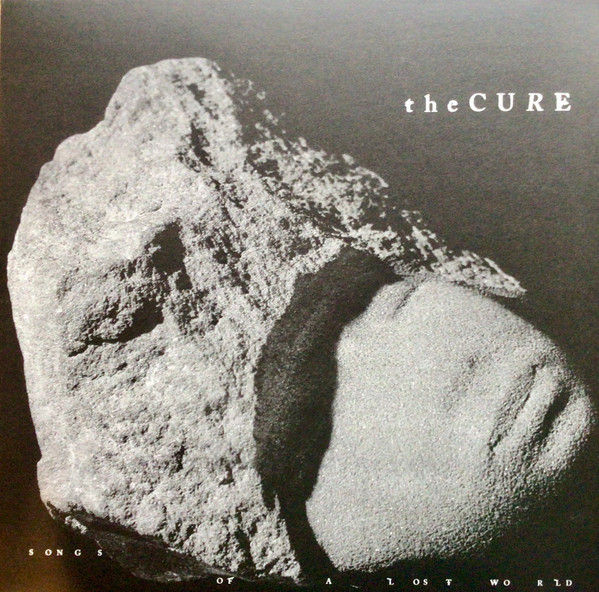
One of the most remarkable things about Songs of a Lost World is not only found in the grooves — it is also on the front cover.
The haunting image is Bagatelle, a 1975 sculpture by Slovenian artist Janez Pirnat. The face appears to emerge from — or disappear back into — a block of stone, perfectly reflecting the album’s themes of memory, loss, time and mortality.
What makes the story even more extraordinary is how Robert Smith discovered it.
According to Smith, he came across a photograph of the sculpture in a book about Pirnat’s work and immediately felt that he had found the visual identity for the album. The image carried the same emotional weight as the music: something half-formed, weathered, ancient and human.
The coincidence around Pirnat’s passing adds another layer to the story. Smith later described the timing as deeply affecting, even though he is not someone who normally speaks in terms of fate. Permission to use the work was later granted by Pirnat’s widow, and Smith eventually acquired the original sculpture.
It is one of those rare cases where the artwork does not simply decorate the music. It becomes part of the album’s meaning.
For me, this is exactly why vinyl collecting matters. A streaming service can play the songs, but it cannot tell the full story in the same way. Holding the record, studying the artwork and discovering stories like this turns an album into something bigger than music. It becomes a piece of art, history and emotion that you can return to again and again.
The Cure remind us why vinyl still matters.
Not because it is fashionable. Not because it is perfect. But because the format suits music that asks for attention. Music with atmosphere. Music with history. Music that deserves more than being skipped after thirty seconds.
A good Cure record is not background music.
It is a place, a mood and a memory.
And on vinyl, that world becomes just a little more real.
Every record has a story.


Comments